
Instead, users rely on a handful of specialized search tools, each indexing a different slice of the dark web landscape. Let’s start by demystifying how dark web search engines actually work. People often turn to the dark web for privacy or to access information not available elsewhere, ranging from anonymous forums to censored content or specialized marketplaces. The above onion links are only for educational purposes. The rest of the wiki also offered links to sites hosting nudity, including child pornography and abuse images. The Onion Router (TOR) network hosts the dark web on its platform, allowing users to remain anonymous while using it.

✅Final Thoughts – Stick To Known, Safe Directories
Another notable security trick Wasabi uses to verify transactions is the Neutrino protocol. It has a feature called CoinJoin that combines multiple coins from different users into a single transaction. Your data is encrypted in the Tor browser before reaching the ZeroBin servers. ZeroBin is a wonderful way to share the content you get from dark web resources. Blockchain even has an HTTPS security certificate for even better protection.

Is It Illegal To Access And Use Dark Web Sites?
- Avoid clicking on suspicious links, disable JavaScript where possible, and never share personal or financial information on dark web sites.
- The best thing about this search engine is, it updates daily.
- The BBC and other well-known news services are blocked in some parts of the world.
- When you connect to the internet through the Tor network, your connection is routed through at least three random nodes, with your data being re-encrypted each time it passes through a node.
Onion sites are considered part of the deep web because search engines like Google and Bing can’t index them. Their URLs (aka dark web links) have .onion as the domain, instead of the common surface web domains like .com or .net. Onion sites (aka Tor sites) are websites only accessible on the dark web; you can’t view them using a regular browser. To protect your data from the websites you visit, one of the most effective steps is to hide your IP address, which can reveal your location, identity, and browsing habits. Different dark web search engines cater to various needs, offering varying levels of privacy, security, and ease of use. While no search engine can cover the entire dark web due to its decentralized and ever-changing nature, Haystak is a top choice for exploring its hidden content.
What Is The Deepest Search Engine?
There are no ads, no tracking, and the interface is reminiscent of early 2000s search engines. It avoids listing illegal marketplaces or shady services, making it ideal for those who want to avoid the darker aspects of the dark web. It offers a sleek interface, a zero-logging policy, and an enormous, frequently updated index of “.onion” sites. It’s often referred to as the “Google of the dark web,” thanks to its vast index of “.onion” sites. Torch is one of the oldest and most reliable dark web search engines out there in the market. In fact, relying solely on Hidden Wiki can limit your access and even the curiosity of finding actual valuable content on the dark web.
How Do I Report Illegal Activity Seen On The Dark Web?
Click its “Onionize” button to search the onion links for any other dark web websites. Beneath the surface web that you’re reading right now, many .onion websites remain invisible to Google and other search engines. The Real World Onion Sites Github is a regularly updated and checked listing of active onion sites, with links to heaps of different services. Read on to find out how to search for onion sites on the Tor network—and how to stay safe while doing so.
BBC News /thai ไทย

At the same time, it is a breeding ground for malicious actors who want to do illegal activities. The creators assert that because their technique is so strong, even malware with root access could not determine the machine’s IP address. Another essential security feature is that all incoming and outgoing data from the app is encrypted, including any private and public keys involved. To prevent detection, the program runs user data via a tiered stream before allowing access to the dark web.
What Is The Dark Web And How To Access It?
Google only indexes websites on the open web (freely accessible and public), while dark web sites use .onion domains that are not visible to traditional search engines. While not strictly a search engine, OnionLinks provides a directory-style resource that helps users discover various .onion sites across different categories. Torch is one of the oldest and most well-known dark web search engines, providing access to a vast index of .onion websites. Ahmia is a popular dark web search engine that indexes .onion websites, making them accessible through the Tor network. To access onion sites, users need a stable internet connection and the Tor browser.
- This .onion site is a bit different from the others reviewed above.
- Your activities on the dark web are not entirely shielded from tracking, and relying solely on anonymity can lead to a false sense of security.
- This means that there will be no data to track your activities.
- Similar to Ahmia, Haystak is also an onion search engine that uses a custom dark web crawler and filters out dangerous content.
For developers and site operators, hosting on the dark web requires privacy, uptime, and resistance to attacks. These services form the communication backbone for sensitive conversations in high-risk environments. Sigaint provides encrypted email favored by whistleblowers and privacy advocates, focusing on ease of use and robust security. The Hub is another well-established forum offering extensive guides and support for newcomers and veterans alike, covering everything from vendor reviews to operational security. Versus Market focuses heavily on security, requiring vendor screening and offering dispute resolution tools.
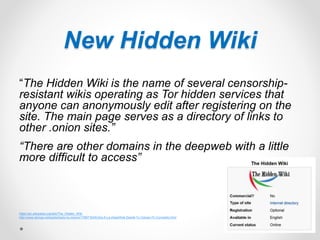
It's important to remember that every active onion site link you click could take you to a phishing site. It also has a long list of non-English language sites too. Although The Hidden Wiki is a general jumping-off point for new darknet visitors, we've relegated it to the bottom of our list. However, just like The Hidden Wiki, consider the links hosted there suspicious. Haystak claims to index over 1.5 billion pages from the dark web while filtering out dangerous search results. Comparatively, if you use Google to search for Facebook, you end up on the social media site, as you'd expect.
The BBC news website has a special .onion site, which you need to access via the dark web. In some countries, such as China and North Korea, the government uses heavy online censorship and blocks many dark web websites. Facebook’s dark web version allows users to access the site where it is banned or restricted. It does not share IP addresses or web search history to protect your privacy.
Is Using Tor Illegal In The US?
The best dark web websites take advantage of the unique encryption infrastructure of The Onion Router (Tor) to provide access to independent news reporting, restricted media, and educational or research materials. There are some darknet search engines mostly created by amateurs and they are very limited due to hidden services nature. There are many tor link lists, wikis and catalogues where you can find addresses to .onion sites. All you need to do is click connect and you are officially connected to the Tor network and can now access dark web websites. However, many are used for illegal activity and onion websites are often popular hangouts for cybercriminals and scammers. Simply put, onion sites are websites that are hosted on the Tor darknet that use the “.onion” top-level domain instead of “.com,” or “.gov” for example.
The internet’s favorite alternative to Google made a name for itself by not logging your search activity yet still providing decent results. That’s why we recommend connecting to VPN before accessing Tor—VPN encryption protects your data, and changing your IP adds an extra layer of privacy to protect you. This is also why the sites on the dark web are called Tor links.